
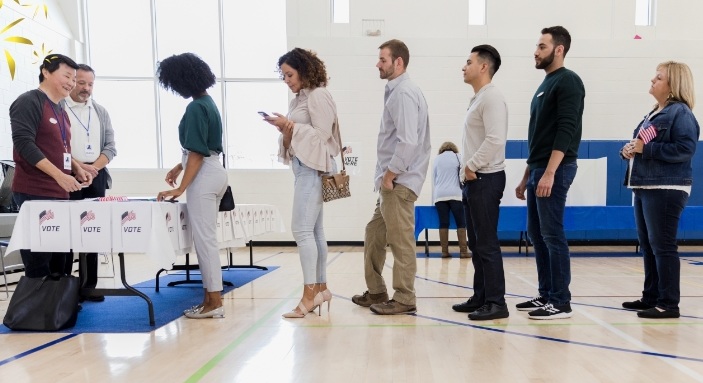
 This Tuesday, November 3rd is Election Day in the United States. If you haven’t been part of this year’s unprecedented early voting surge, go out on Tuesday and vote for your U.S. senator(s) and representative(s), governor, attorney general, state representatives and senators, secretary of state, etc.
And don’t forget to vote for down-ballot officials, such as city and county officials, library and school boards, sheriffs, elected judges, and more. Your local officials often hold more sway over daily life in your community – as do the multitude of ballot measures being decided in this election. Find your polling place information here.
Social Class Advocates Vote
As a social class advocate, you are actively working and hoping for class justice and social change. But too many of you have given up on one of the most important things you can do to affect justice. According to Isaac Saul, editor of Tangle, “It’s no secret that many Americans are cynical about the value of their vote. The U.S. tends to sit pretty far down the list of developed nations.”
For many eligible voters, apathy is the reason they stay home on Election Day. But for many of our working class family, friends and fellow congregants, registering to vote and voting can be difficult. Finding time to register is hard when you juggle multiple part-time or gig jobs and child care. It can be impossible when you do not have a required stable home address.
Voting itself requires making time-consuming and expensive transportation connections in parts of the city where many people with less class advantage reside. It may require taking time off from work or getting to a polling place before or after work. The closure of polling places in poorer neighborhoods across the nation has meant that waiting in line to vote can take hours. Many hourly workers do not have that luxury.
As with registering, for many parents, voting may require finding child care. And far too many eligible voters are afraid of being picked up by ICE (despite their eligibility) and detained (and even unlawfully deported) if they show up to vote.
But for those of us lucky enough not to be burdened by these problems, voting in elected officials who can make voting easier for our less class advantaged and racially profiled brethren is our duty. More importantly, we can vote in elected officials who will work to:
- support policies that provide more social class advantage for those living in poverty
- offer a lifeline to working and middle class people struggling to make ends meet in these inflationary times
- and even provide more opportunities for class-advantaged people drowning in debt or losing their health care
Equal Voices
“There will be no End of it,” a worried John Adams wrote in May 1776. With dependence imminent, his native Massachusetts was considering expanded voting rights beyond property-owning men. If they pursued this “dangerous” idea, he predicted, “New Claims will arise. Women will demand a Vote . . . and every Man, who has not a Farthing, will demand an equal Voice with any other in all Acts of State.” It would be an endless “Source of Controversy and Altercation.” Colonial Williamsburg
Adams was right. Many fought and died for the right to vote. Treated more brutally than their middle and owning class counterparts, working-class suffragettes were imprisoned, beaten, force-fed, lost custody of their children, and lost their livelihoods to vote. Black children and adults were murdered to keep Blacks from voting. Native Americans were not able to vote – in their own land – until 1948. Disabled Americans have had to fight for handicap access to voting places. Americans for whom English is a second language fought for ballots in non-English languages. And on and on …
So raise your equal voice and vote on November 3rd! The future of the United States depends on you.